Marketing
10 WhatsApp Automation Flows Every E-commerce Brand Must Have in 2026
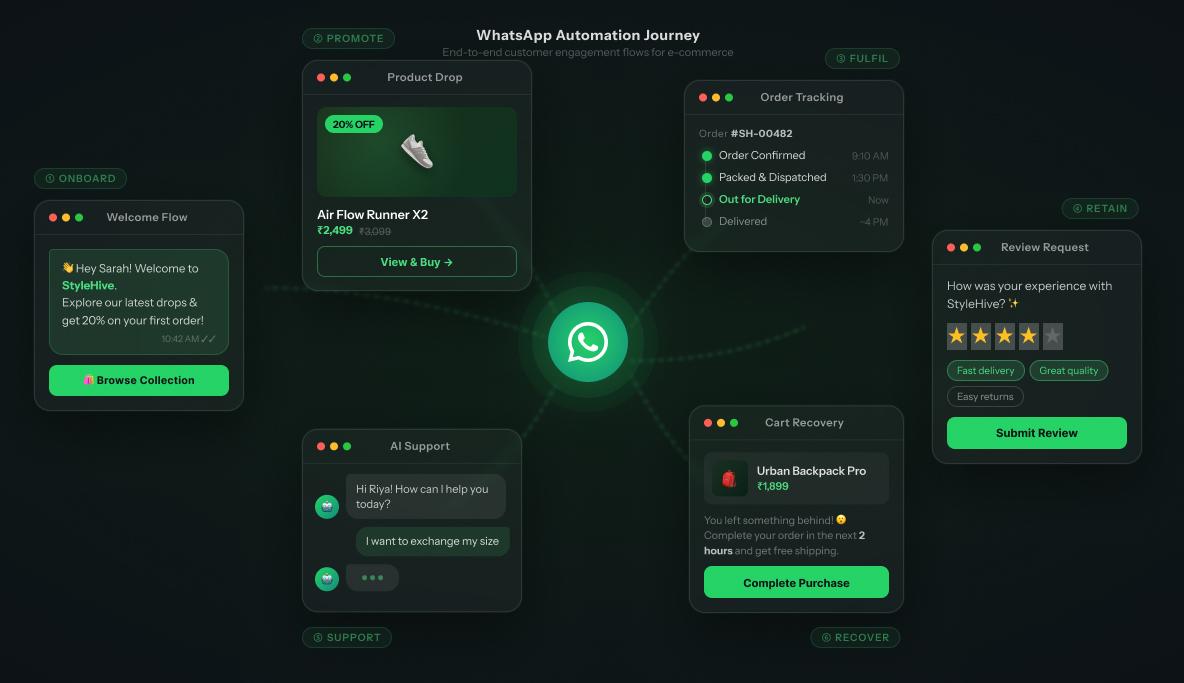
Your Customers Are Already on WhatsApp. Your Sales Shouldn't Miss Them
Here's a brutal truth. Your customers check WhatsApp 150+ times per day. They open messages within minutes of receiving them. They've trained their brains to respond to WhatsApp instantly.
But your e-commerce business? Still relying on email. Still hoping they see your shipping notification in a spam folder. Still watching abandoned carts go unrecovered because a generic email sits unread.
This is leaving money on the table. Massive amounts of it.
In 2026, e-commerce isn't about selling products. It's about conversations. And WhatsApp is where those conversations happen. The problem is most brands don't know which conversations matter or how to automate them properly.
They set up one or two flows and call it done. They don't realize there are specific, high-impact automation sequences that are proven to recover lost sales, reduce customer support tickets, and build lifetime loyalty.
This guide covers all 10 of them. The flows that separate average e-commerce brands from the ones that convert at 2x, 3x, sometimes 5x rates.
Each flow has a specific job. A specific trigger. A specific timing. A specific message structure. Get them right, and you'll watch your conversion rates climb. Get them wrong, and you'll waste money on abandoned infrastructure.
By the end, you'll understand exactly which flows you need, why they work, and how to implement them.
What Are WhatsApp Automation Flows? (And Why They Actually Matter)
An automation flow is a sequence of messages triggered by a customer action. You don't send them manually. You set them up once, and they run forever, across thousands of customers, automatically.
Here's how it works. A customer abandons their cart. The system detects this instantly. After 45 minutes, WhatsApp sends them a reminder automatically. If they don't return, a second message goes out at 9 PM. If they still don't convert, a third message offers free shipping.
Throughout this entire sequence, you're not touching anything. No manual sending. No team member involvement. The automation handles everything.
This matters for one reason: consistency at scale.
Email marketing? You'll get 20% open rates if you're lucky. SMS? 98% open rate, but they're expensive and impersonal. WhatsApp? 98% open rate, read within minutes, personal, and you pay only when someone opens the message.
The math is simple. A single recovered cart is ₹1,000 to ₹10,000 in revenue. If your automation recovers just 10% of abandoned carts, you've made back your investment in days.
But here's what most brands miss: not all flows are equal. Some flows recover massive revenue (abandoned carts). Some build loyalty slowly (review requests). Some reduce operational costs (delivery confirmations). You need all 10 because together they cover your entire customer journey.
Flow 1: Abandoned Cart Recovery (The Revenue Machine)
The Challenge:
70% of e-commerce carts are abandoned. That's not a bug in your store. That's the e-commerce industry baseline. Customers add items, get distracted, change their mind, compare prices, get sticker shock—then they leave.
Each abandoned cart represents lost revenue. For a ₹5,000 average cart value and a 10% recovery rate, you're recovering ₹500 per customer. With 100 abandoned carts per day, that's ₹50,000 in recovered revenue daily. That's ₹1.5M monthly.
Most brands never recover these carts. Email reminders get ignored. SMS feels pushy. But WhatsApp? People check it constantly.
How It Works:
When a customer abandons checkout, your system immediately marks their cart as abandoned. A 45-minute timer starts. Once it hits, WhatsApp sends a message reminder with the products they left behind and a direct link back to their cart.
The First Message (45 Minutes After Abandonment):
"Hi {{name}}, you left {{product_count}} items in your cart 🛒 Your items: • {{product_1}} - ₹{{price_1}} Complete checkout here: {{cart_link}} Use code HURRY10 for 10% off (expires in 24 hours)" |
Why This Timing: The product is still top-of-mind. They haven't fully moved on. The urgency of an expiring code creates tension without being pushy.
Expected Result: 20-30% of customers return and complete purchase. That's 1 in 3-5 abandoned carts recovered.
If No Action After 8 Hours:
"Still interested in {{product_1}}, {{name}}? We reserved your cart. But it disappears in 2 hours. Cart link: {{cart_link}}" |
Why This Works: Scarcity combined with simplicity. No offer this time. Just urgency.
Expected Result: Another 10-15% of the remaining carts convert.
If Still No Action After 24 Hours:
"Last chance, {{name}} 🔴 Your {{product_1}} is now out of stock for 200+ other customers. We're releasing your reservation in 1 hour. Grab it now: {{cart_link}}" |
Why This Works: FOMO. Social proof. Urgency tied to inventory.
Expected Result: Another 5-10% convert.
Total Recovery From This Flow: 30-45% of abandoned carts. On 100 abandoned carts, that's 30-45 recovered sales.
Flow 2: Order Confirmation (The Trust Builder)
The Challenge:
A customer just gave you money. The moment they complete checkout, they wonder: "Did it work? Is my order real? Will it arrive?"
Sending a confirmation email? Good. But it's gone in seconds. Lost in the inbox. They'll never see it.
How It Works:
The second an order completes, WhatsApp sends an instant confirmation. Not an email. Not a push notification. WhatsApp. Where they're already looking.
The Message:
"Order confirmed! 🎉 Order #{{order_id}} Items: {{product_count}} Total: ₹{{order_amount}} Estimated delivery: {{delivery_date}} Track your order here: {{tracking_link}}" |
Timing: Sent within 60 seconds of purchase. Instant.
Expected Result: Immediate peace of mind. Eliminates "Did my order go through?" support questions. Reduces anxiety-driven refund requests.
Flow 3: Shipping Update (The Tracking Killer)
The Challenge:
"Where is my order?" is the #1 customer support question for e-commerce brands. Every time a customer asks, you lose an agent for 3 minutes. Multiply by thousands of orders, and you're hemorrhaging productivity.
How It Works:
When an order ships from your warehouse, WhatsApp automatically sends a message with tracking details and a link to track the package in real-time.
The Message:
"Your order shipped! 📦 Order #{{order_id}} Courier: {{courier_name}} Tracking #: {{tracking_number}} Track live: {{tracking_link}} It arrives by {{delivery_date}}" |
Timing: The moment the order leaves your warehouse.
Expected Result: 60% reduction in "Where's my order?" support tickets. Customers proactively track instead of asking.
Flow 4: Delivery Confirmation (The Accountability Moment)
The Challenge:
Delivery day is critical. Packages get lost. Wrong addresses. Customers miss deliveries. When things go wrong, the first person they blame is you, not the courier.
How It Works:
When the package is out for delivery, WhatsApp sends a heads-up. When it arrives, it sends a delivery confirmation. This manages expectations and documents proof of delivery.
The Message (Out for Delivery):
"Your package is out for delivery! 🚚 Order #{{order_id}} Driver: {{driver_name}} Driver contact: {{driver_phone}} Estimated arrival: {{time_window}} today Make sure someone's home!" |
The Message (Delivered):
"Delivered! ✅ Order #{{order_id}} Delivered at: {{delivery_time}} Received by: {{receiver_name}} Any issues? Reply here." |
Timing: Immediately when status updates.
Expected Result: Fewer missed deliveries (customers are ready). Fewer disputes (confirmation sent immediately). Fewer returns due to complaints about delivery experience.
Flow 5: Post-Purchase Review Request (The Social Proof Maker)
The Challenge:
Reviews are gold. They drive conversions, boost SEO, build social proof. But most customers never leave reviews. They'd have to go back to your site, find the product, click review, write something. Too many steps.
How It Works:
3-5 days after delivery, WhatsApp asks them to rate their experience. One tap. Done.
The Message:
"How was your delivery, {{name}}? ⭐ Order #{{order_id}} - {{product_name}} Rate your experience: ⭐⭐⭐⭐⭐ (5 stars) ⭐⭐⭐⭐ (4 stars) ⭐⭐⭐ (3 stars) Link to review: {{review_link}}" |
Timing: 3-5 days after delivery. Long enough that they've used/evaluated the product. Short enough to remember the experience.
Expected Result: 15-25% of customers leave a review (vs. 1-2% without automation). A surge in social proof that drives more conversions.
Flow 6: Back-in-Stock Alert (The FOMO Converter)
The Challenge:
A customer visits your store. Sees a product they love. It's out of stock. They leave. They forget about it. You lose a customer.
But what if you remind them the second it's back?
How It Works:
When a customer clicks "Notify me" on an out-of-stock product, you capture their WhatsApp number. The moment inventory replenishes, WhatsApp sends them an instant alert.
The Message:
"Great news, {{name}}! 🎉 {{product_name}} is back in stock! Only {{quantity}} left. Shop now: {{product_link}}" |
Timing: Instantly when stock is added.
Expected Result: 30-50% conversion on back-in-stock alerts. These are hot-lead customers who already wanted the product.
Flow 7: Flash Sale Broadcast (The Revenue Spike)
The Challenge:
You're running a flash sale. 3 hours only. Massive discount. But you need to reach customers fast. Email won't work (takes hours to open). WhatsApp will.
How It Works:
You send a broadcast message to your WhatsApp subscribers announcing the flash sale. Include the discount code, deadline, and a direct link.
The Message:
"⏰ FLASH SALE - 3 Hours Only! Get 40% off on {{category}} Use code: FLASH40 Expires: {{end_time}} today Shop now: {{sale_link}}" |
Timing: Right when the sale goes live.
Expected Result: 15-25% of subscribers convert during the sale window. For a 10,000-subscriber list, that's 1,500-2,500 orders. At ₹3,000 average, that's ₹4.5M-7.5M in revenue from a single flash sale.
Flow 8: Re-engagement / Win-Back Campaign (The Second Chance)
The Challenge:
You have customers who bought once, then disappeared. They haven't purchased in 60+ days. They're not inactive—they're just dormant. A single message can reactivate them.
How It Works:
For customers who haven't purchased in 60 days, send a "we miss you" campaign offering them a reason to come back.
Message 1 (Day 60):
"We miss you, {{name}}! 🥺 It's been {{days}} days since your last order. Come back and get 20% off your next purchase. Use code: COMEBACK20 Shop: {{store_link}}" |
Message 2 (If No Action, Day 75):
"{{name}}, this offer expires tomorrow. 20% off everything. Just for you. Code: COMEBACK20" |
Timing: Spaced 2 weeks apart.
Expected Result: 10-20% of dormant customers reactivate and purchase again. For 10,000 dormant customers, that's 1,000-2,000 returning buyers.
Flow 9: Welcome Series for New Subscribers (The First Impression)
The Challenge:
A customer just opted into your WhatsApp list. This is a golden moment. They're interested. You have their attention. Most brands waste it with a generic "thanks for subscribing" message.
How It Works:
A 3-message welcome series educates, builds trust, and offers an incentive to make their first purchase.
Message 1 (Immediately):
"Welcome to {{brand_name}}, {{name}}! 🎉 You're now on our VIP WhatsApp list. Here's what you get: 📦 Exclusive WhatsApp-only deals ✅ Order updates & tracking ⚡ Flash sales & early access Excited to have you!" |
Message 2 (Hour 2):
"Here's your welcome gift: Use code WELCOME15 for 15% off your first order. Valid for 48 hours only. Browse our bestsellers: {{bestseller_link}}" |
Message 3 (Day 2):
"Don't have anything yet? Here's what customers love: {{top_3_products}} Any questions? Just reply!" |
Timing: Spaced 2 hours, then 1 day apart.
Expected Result: 20-35% of new subscribers make their first purchase using the welcome offer. For 1,000 new subscribers, that's 200-350 conversions.
Flow 10: COD Confirmation & Prepaid Nudge (The India-Specific Revenue Lifter)
The Challenge (India-Specific):
In India, ~60% of e-commerce orders are Cash on Delivery (COD). Customers don't commit to payment until the package arrives. This creates massive fraud risk and Return to Origin (RTO) losses.
If a customer orders COD, you need to confirm they're serious. You need to nudge them toward prepaid (lower RTO risk).
How It Works:
When a customer places a COD order, you send an immediate confirmation asking them to confirm. You also offer a discount if they prepay instead.
Message 1 (Immediate - COD Confirmation):
"Hi {{name}}, your COD order is confirmed! ✅ Order #{{order_id}} Amount: ₹{{amount}} (to pay on delivery) Deliver to: {{address}} Is this address correct?" |
Expected Result: Confirms address is correct. Prevents wrong deliveries. RTO loss reduction: 15-25%.
Message 2 (Hour 4 - Prepaid Nudge):
"Great news! 💰
Pay now and get 5% extra discount.
Amount: ₹{{prepaid_amount}} (Instead of ₹{{cod_amount}} on delivery)
Pay now: {{payment_link}}"
Expected Result: 10-20% of COD customers convert to prepaid. This dramatically reduces RTO losses.
How to Implement These Flows
These flows work. But they only work if implemented correctly. Here's what you need:
Step 1: Choose the Right Platform
You need a WhatsApp automation platform that can handle all 10 flows seamlessly. Most platforms focus on one flow (abandoned cart) and skimp on the others.
You need a platform like Vaakuos that:
Automates all 10 flows out of the box
Integrates with Shopify, WooCommerce, and other major platforms
Handles template approvals for you
Provides detailed analytics on each flow
Offers compliance monitoring so you never violate WhatsApp policies
Includes omnichannel (Email + SMS + WhatsApp in one dashboard)
Step 2: Set Up Your Templates
Each flow needs pre-approved WhatsApp templates. You'll create them once, Meta approves them, and they run forever.
Step 3: Connect Your Store
Integrate your e-commerce platform (Shopify, WooCommerce, etc.) with your WhatsApp platform. This ensures cart abandonment data, order data, and customer data flow automatically.
Step 4: Customize Timing & Copy
Each flow has default timings and message copy. Customize them to match your brand and customer behavior.
Step 5: Monitor & Optimize
Track metrics for each flow. Conversion rates. Click-through rates. Message open rates. Optimize based on data.
Expected Results: What These 10 Flows Can Generate
Let's be concrete. Here's what a mid-sized e-commerce brand (10,000 customers, ₹50 lakh monthly revenue) can expect:
Flow 1 (Abandoned Cart): Recover 30-40 carts daily = ₹30,000-40,000 additional daily revenue = ₹9-12L monthly
Flow 2 (Order Confirmation): Reduce refund requests by 10-15% = Save ₹5,000 monthly
Flow 3 (Shipping Updates): Reduce support tickets by 50% = Save 40 hours/week = ₹50,000+ monthly
Flow 4 (Delivery Confirmation): Reduce RTO by 15% = Save ₹50,000 monthly
Flow 5 (Review Requests): Increase review count by 400% = Better SEO + social proof = 5-10% conversion lift = ₹2.5-5L monthly
Flow 6 (Back-in-Stock): Recover 10 out-of-stock customers = ₹1,00,000 monthly
Flow 7 (Flash Sales): Incremental from VIP list = ₹5-10L per sale (quarterly)
Flow 8 (Win-Back): Reactivate 5% of dormant customers = ₹2-3L monthly
Flow 9 (Welcome Series): Convert 25% of new subscribers = 250 additional orders = ₹75L monthly
Flow 10 (COD/Prepaid): Reduce RTO by 20%, increase conversion = ₹3L monthly
Total Monthly Impact: ₹40L+ in additional revenue + operational savings.
For a ₹3,000/month WhatsApp automation platform, your ROI is 1300x.
Why Most Brands Only Use 1-2 Flows (And Why That's Costing Them)
Here's the brutal truth. Most e-commerce brands using WhatsApp automation only implement abandoned cart recovery. Maybe order confirmations.
They see the quick ROI from abandoned carts and think they've optimized WhatsApp.
They haven't.
Abandoned cart recovery is the low-hanging fruit. It's obvious. So everyone does it. But the real competitive advantage is the other 9 flows.
Brands implementing all 10 flows are:
Converting 2-3x more customers
Building loyalty through review requests and win-back campaigns
Reducing operational costs (fewer support tickets)
Preventing fraud (COD confirmation)
Creating urgency (flash sales, back-in-stock)
Building trust (order confirmation, shipping updates)
This isn't theory. These are tested flows from brands doing ₹100 Cr+ in annual revenue.
The ROI Is Undeniable, But Only If You Get All 10
A single abandoned cart flow generates 20-30% additional revenue. But it plateaus. Customers see similar messages from your competitors. The novelty wears off.
All 10 flows work together. They create a comprehensive ecosystem where customers feel:
Informed (shipping updates)
Cared for (delivery confirmation)
Valued (welcome series)
Engaged (flash sales)
Loyal (review requests)
This ecosystem compounds. Customers become brand advocates. They stay longer. They buy more frequently. They refer friends.
The math: An e-commerce brand with 10,000 customers and ₹50L revenue can add ₹40L+ monthly by implementing all 10 flows properly.
Most brands are missing ₹40L monthly because they don't know these flows exist.
Ready to Implement All 10 Flows?
Implementing these flows manually is nearly impossible. You'd need developers. You'd need to manage 10 separate campaigns. You'd need to monitor templates.
This is why you need a proper WhatsApp automation partner. Not a cheap tool that does abandoned carts. Not a developer-focused API. An actual platform built for e-commerce brands.
Vaakuos is exactly that. We've built all 10 flows into the platform. You connect your store, customize the timing and copy, and they run forever. Automatically. At scale.
No developers needed. No complex setup. Just results.
Ready to recover ₹40L+ monthly from your existing customer base?
Start with Vaakuos today. Get all 10 flows running within 48 hours. Watch your revenue climb.