Marketing
Whatsapp Marketing ROI - The 5 KPIs Every Brand Must Track in 2026
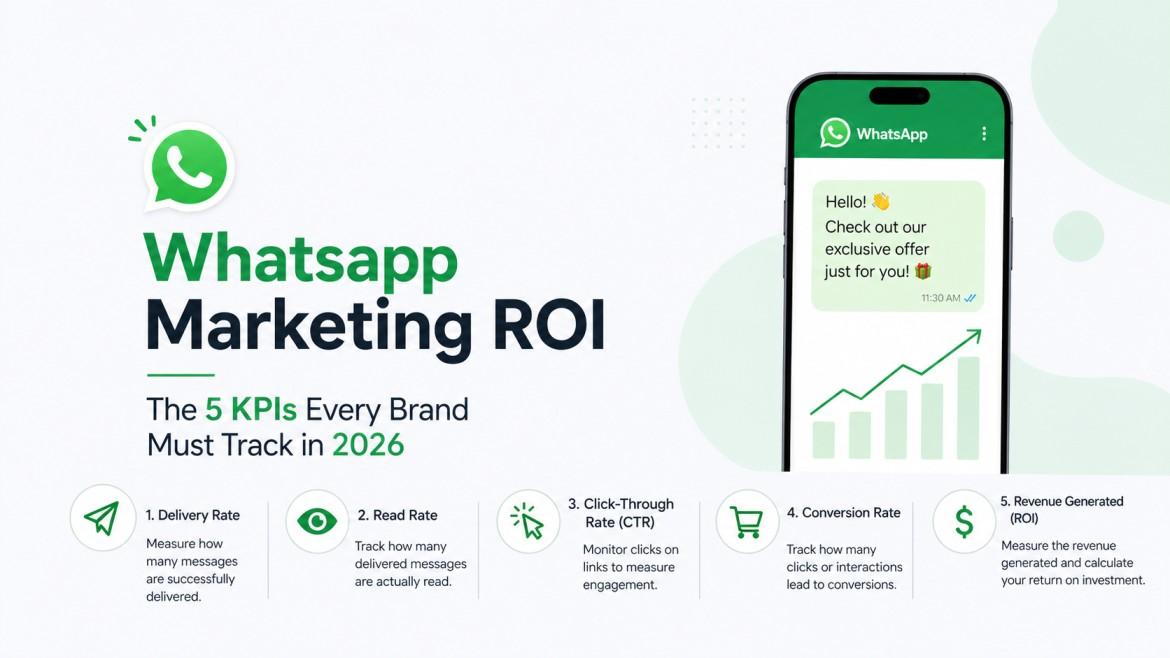
WhatsApp Marketing ROI: The 5 KPIs Every Brand Must Track in 2026
WhatsApp is no longer an experiment in your marketing mix. It is the channel where your customers actually open messages, reply within minutes, and complete purchases. The question is no longer whether to invest in it — the question is how to prove it pays back. And that proof comes down to the right KPIs, defined the same way every month, and reported against the same baseline every quarter.
If you are running WhatsApp marketing campaigns in 2026 without a tight measurement framework, you are flying blind. This guide walks through the five KPIs that define WhatsApp marketing ROI — what they are, how to compute them, what good looks like, and how to instrument them in your stack so a finance partner can audit every number you publish.
Why WhatsApp marketing ROI is different from email or ads in 2026
Two things separate WhatsApp from older marketing channels. The first is scale and engagement. According to Statista, WhatsApp had three billion monthly active users as of March 2025, up from over two billion in March 2020. That ubiquity means the channel does not need awareness budget — your customers already use it. They just need a reason to open a message from your brand.
The second is line-item cost visibility. WhatsApp Business is per-message-priced, which makes every campaign accountable to the rupee. You can no longer hide a poorly-targeted broadcast in a flat monthly fee. Every send is a billed event. That is uncomfortable for marketers used to sandbagging — and a gift to the ones who measure carefully.
The market has noticed. According to HubSpot's 2026 State of Marketing report, 10.5% of marketers say messaging — SMS, WhatsApp, Messenger — is one of their biggest ROI drivers, and nearly 75% plan to increase or maintain their messaging investment in 2026. The budgets are coming. The question is whether your reporting will earn its share. If you want to understand why WhatsApp leads on engagement before you wire up KPIs, that primer is a useful pre-read.
KPI 1: Delivery rate (and why it is the silent ROI killer)
Formula: Delivery rate = delivered messages ÷ sent messages.
This is the KPI most marketers ignore because it sounds like an engineering metric. It is not. Delivery rate caps every other KPI in the funnel. If only 80% of your messages reach inboxes, your CTR, conversion, and recovery numbers all start from a 20% deficit — and worse, they look fine in the dashboard because the denominator is "delivered," not "sent."
Healthy delivery rates on a WhatsApp Business API account in good standing typically sit above 95%. The drop-off comes from three places: stale opt-in lists, low template quality scores, and customers who have blocked your number. Each has a different fix, and each costs you real money.
What hurts delivery
Opt-in hygiene: any contact added without an explicit opt-in is one user-block away from a quality-score drop. Audit your opt-in source for every list segment.
Template quality: Meta scores templates on user-reported quality. A template that gets flagged as spam by even a small slice of recipients can throttle delivery for the entire account.
Frequency: more sends per week to the same recipient correlates with more user blocks. Frequency caps protect your delivery rate.
In practice: a brand we surveyed before they migrated platforms had 88% delivery on broadcasts. After cleaning their opt-in list and rotating two of their lower-scoring templates, that climbed past 95%. None of the downstream KPIs changed — and yet revenue per send went up, simply because more sends actually arrived.
KPI 2: Click-through rate on marketing templates
Formula: CTR = template button clicks ÷ delivered messages.
CTR is where copy, creative, and segmentation get judged. Every WhatsApp marketing template can carry up to three buttons, and the right button copy can double or halve your downstream conversion. Treat CTR as the gate between your message arriving and your customer actually engaging with the offer.
A useful working benchmark for WhatsApp marketing CTR is 8–18% on segmented broadcasts, with promotional offers typically at the top of that band and informational templates at the bottom. Cold, ungated broadcasts to an entire list will run lower. The number itself matters less than the trend — a CTR sliding from 14% to 10% on the same template is your canary that creative fatigue has set in or your segment has saturated.
How to lift CTR without burning frequency
Personalize the headline, not just the salutation. A first-name token is worth far less than a product the customer actually browsed.
Match button copy to intent. "Buy now" and "See your size" perform very differently on the same offer.
Send at conversation hours, not at scheduled-tool hours. If your audience is in India, late evenings and weekends typically outperform working hours for D2C offers.
Tag every button click with a UTM-style identifier so the click rolls up to the right campaign in your analytics. Without that tag, CTR is a vanity number.
KPI 3: Conversion rate from WhatsApp click to checkout
Formula: Conversion rate = orders attributed to WhatsApp ÷ template button clicks.
Once a customer clicks a WhatsApp button, you are competing with the same friction that breaks every checkout. According to Shopify's enterprise checkout research, the overall ecommerce conversion rate sits around 3%, which means the gap between "interested click" and "completed order" is the most expensive funnel stage you own.
The same Shopify research, citing Baymard Institute data, lays out where shoppers drop off: extra costs surprise 48%, required account creation drops 26%, credit-card security concerns 25%, slow delivery 23%, and complex checkouts 22%. Every one of those is a fix you can ship without rewriting your WhatsApp strategy — and every one disproportionately hurts WhatsApp campaigns because the channel sets a high expectation of speed.
Lifting WhatsApp click-to-checkout conversion
Send a payment-link template, not a deep link to a generic product page. Each extra click between the message and the checkout costs you conversion.
Pre-fill the cart when possible — if your messaging platform integrates with Shopify or WooCommerce, the cart should hydrate from the customer's last session.
Strip account creation for first-time buyers; Shop Pay-style guest flows convert as much as 50% better than typical guest checkouts according to the same Shopify research.
A WhatsApp click-to-checkout conversion rate of 6–12% on a warm segment is realistic for D2C in India. Anything below 4% on warm segments suggests a checkout problem, not a message problem.
KPI 4: Cart-recovery contribution (the headline metric for D2C)
Formula: Cart-recovery rate = recovered carts ÷ abandoned carts within window.
Cart recovery is the KPI that makes or breaks the WhatsApp ROI case for any D2C brand. The opportunity is enormous: Statista's 2026 cart abandonment data reports that 70.22% of online shopping carts were abandoned in 2026, broadly consistent with the 70.19% figure Baymard Institute published for 2024 and which Shopify continues to reference. Of every ten carts your brand fills, seven leave without paying. WhatsApp is the channel best placed to bring some of them back.
Define your recovery window before you measure anything. A 24-hour window is standard for D2C — past that, the cart is cold and the customer has either bought elsewhere or moved on. Inside that window, a WhatsApp cart-recovery flow typically runs three nudges: a soft reminder at 30 minutes, a value reinforcement (free shipping, a small incentive) at 4–8 hours, and a final urgency message before the window closes.
Worked example
Take a D2C brand with 1,000 abandoned carts in a month and an average order value of ₹2,000. With a 12% WhatsApp-attributed cart-recovery rate, the math is straightforward: 1,000 abandons × ₹2,000 AOV = ₹20,00,000 in abandoned-cart pipeline. Apply a 12% recovery: 0.12 × ₹20,00,000 = ₹2,40,000 in recovered revenue per month, or ₹28,80,000 across a year. That single KPI typically funds the entire WhatsApp programme on its own.
The trap is attribution. If a customer abandons, sees a Google retargeting ad, and then opens your WhatsApp message before completing the order, who gets the credit? Set a clear last-touch rule before you build the dashboard. We recommend last-touch within a 24-hour window, with WhatsApp credited only when the customer actually clicked the recovery message. That is conservative, defensible, and matches what a finance partner will accept.
If your platform supports cart-recovery flows wired into your store, most of this attribution work is handled at the event-pipeline level rather than in spreadsheets — which is the only way to keep this KPI honest at volume.
KPI 5: Cost-per-recovered-revenue and gross ROI
Formula: Cost-per-recovered-revenue (CPRR) = total WhatsApp marketing spend ÷ attributed recovered revenue.
CPRR is the KPI a CFO will ask about. It collapses your entire WhatsApp programme into a single percentage: out of every rupee of revenue WhatsApp generated, how much did the channel cost? Anything under 10% on a mature programme is a strong result. Under 5% is exceptional and usually means your delivery, CTR, and conversion KPIs are all working in concert.
Worked example
Stay with the same D2C brand. Suppose the recovery flow sends 50,000 marketing templates in a month at an illustrative ₹1.50 per template, for a spend of 50,000 × ₹1.50 = ₹75,000. Of those, 12% click through, giving 50,000 × 0.12 = 6,000 clicks. Of those clicks, 8% convert in the click-to-checkout flow, giving 6,000 × 0.08 = 480 orders. At a ₹2,000 AOV, that is 480 × ₹2,000 = ₹9,60,000 in attributed revenue.
CPRR = ₹75,000 ÷ ₹9,60,000 ≈ 7.8%. In other words, the channel costs roughly 7.8% of the revenue it generates. That ratio is the single number you publish to leadership.
Why CPRR beats "ROAS"
ROAS — return on ad spend — flatters WhatsApp because the per-message rates are low. A ROAS of 10× sounds impressive but tells you nothing about whether your underlying funnel is leaky. CPRR forces you to combine spend, attribution, and revenue in one ratio, which is harder to game and easier to compare across channels.
Run CPRR on a transparent per-message rate card so the spend half of the ratio is auditable. If your platform charges flat fees that scale with volume in disguise, your CPRR is a fiction.
How to instrument these 5 KPIs in your stack
Reporting frameworks fail when they live in three different tools. Wire all five KPIs into a single weekly dashboard, sourced from one event pipeline.
Tag every template at send-time with a UTM-style identifier — campaign, segment, variant. Without tags, none of the downstream KPIs roll up correctly.
Pipe ecommerce events into your messaging platform through your Shopify or WooCommerce integration so cart abandonment, order completion, and refund events all hit the same warehouse.
Define attribution windows once, in writing, and apply them consistently. Last-touch within 24 hours for cart recovery, last-touch within 7 days for broadcast campaigns, is a defensible default.
Audit the dashboard quarterly against raw event data. Numbers drift when nobody looks.
Build the dashboard around weekly data, not monthly — most WhatsApp marketing problems show up as a 1–2 week trend break, and a monthly cadence is too slow to catch them.
Wrap-up. WhatsApp marketing ROI in 2026 is not a black box. It is five KPIs — delivery rate, click-through rate, click-to-checkout conversion, cart-recovery contribution, and cost-per-recovered-revenue — measured the same way every week, audited against your event pipeline, and reported in a single dashboard. Get those five right and you can defend every rupee of spend. Get them wrong and even the best campaign will look like guesswork to your CFO.
Primary CTA: Ready to put a measurement-first WhatsApp marketing programme in place? Register your interest in Vaakuos and we will walk you through how the platform reports each of these five KPIs out of the box.
Secondary CTA: Want to see what your CPRR could be on your current volumes? Calculate your WhatsApp marketing ROI with our scenario tool.
Frequently Asked Questions
What is a good ROI for WhatsApp marketing campaigns?
A mature WhatsApp marketing programme typically runs at a cost-per-recovered-revenue (CPRR) of under 10%, meaning the channel costs less than 10% of the revenue it generates. Programmes under 5% CPRR are exceptional and usually depend on tight delivery, segmentation, and attribution. ROAS-style framings flatter the channel; CPRR is the more honest metric.
How do I measure conversion rate on WhatsApp marketing templates?
Define conversion as orders attributed to WhatsApp divided by template button clicks. Tag every template with a UTM-style identifier at send-time, then attribute orders that complete within a clear window — typically 24 hours for cart-recovery flows and 7 days for broadcast campaigns. Apply last-touch attribution and only credit WhatsApp when the customer actually clicked the message.
Is WhatsApp marketing more profitable than email or SMS?
For warm D2C audiences in markets like India, WhatsApp typically delivers higher engagement than email or SMS at comparable or lower per-message cost. According to HubSpot's 2026 State of Marketing report, 10.5% of marketers cite messaging as one of their biggest ROI drivers and 75% plan to maintain or grow messaging investment. The honest answer is channel-mix dependent — track CPRR for each channel and let the numbers decide.
How do I attribute WhatsApp revenue back to specific campaigns?
Two requirements: tag every outbound template with a UTM-style identifier (campaign, segment, variant) and pipe Shopify or WooCommerce order events into the same warehouse as your messaging logs. Then apply a documented attribution rule — last-touch within a 24-hour window for cart recovery is the standard. Without both the tag and the event pipeline, attribution becomes guesswork.
What WhatsApp marketing KPIs should a D2C brand report monthly?
Five KPIs: delivery rate, click-through rate, click-to-checkout conversion rate, cart-recovery contribution, and cost-per-recovered-revenue. Report them on a single weekly dashboard with monthly rollups for finance. The first three are diagnostic — they tell you where the funnel is leaking. The last two are commercial — they tell you whether the channel is paying back. Both halves are needed to defend the budget.