Marketing
Omnichannel vs. Multichannel Marketing—What's the Real Difference?
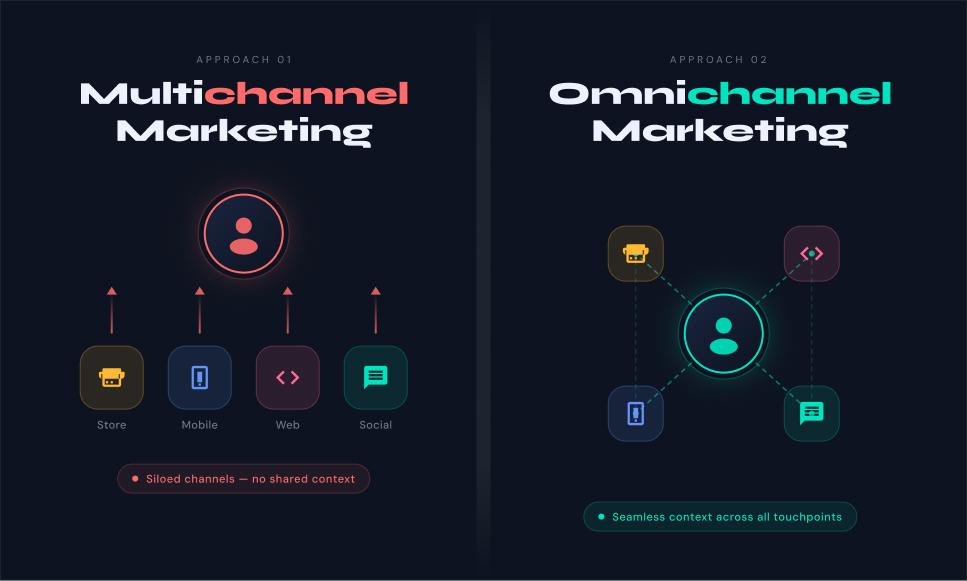
You hear these terms constantly. Omnichannel. Multichannel. Leaders use them interchangeably at conferences. Consultants throw them around like they're the same thing. Articles mix them up. Most brand owners honestly don't know the difference.
But here's the thing: getting this wrong is costing you millions in lost revenue.
The difference between omnichannel and multichannel isn't semantic. It's not a minor distinction. It's the difference between a fragmented customer experience that confuses people and a seamless journey that converts them into loyal customers.
One approach treats your customer like a stranger every time they switch channels. The other remembers them. Knows them. Anticipates what they want.
Multichannel brands are still winning sales. But omnichannel brands are building empires.
Let me explain the real difference. And show you why Indian D2C brands that figured this out are growing 10x faster than their competitors.
Multichannel Marketing: Being Everywhere, But Disconnected
Multichannel marketing is simple to understand. It means you're selling on multiple platforms. Your website. Your Instagram. Your Facebook. Your WhatsApp. Marketplace platforms like Flipkart and Amazon. Maybe a physical store or two.
You're everywhere your customer might be. That sounds good. It is good. But here's the reality.
Each channel operates independently. Your website team doesn't talk to your social media team. Your email campaign doesn't know what offer your Instagram is promoting. Your store associate has no idea what the customer bought online last month.
The customer sees different messages on different platforms. Sometimes conflicting messages. Sometimes the same message is repeated annoyingly. Sometimes there are completely different products and offers on each channel.
Let me give you a real example. A customer visits a beauty brand's website. They browse a foundation. They don't buy. They leave.
The next day, they get an email. But not about the foundation they looked at. The email is a generic "New collection launch" message sent to everyone. The customer thinks, "This brand doesn't remember me." They delete it.
Meanwhile, they see an Instagram ad from the same brand promoting a completely different product (a lipstick on sale). The messaging is totally different from the email. Same brand, two completely different conversations.
Then they visit the brand's physical store. The store associate has no idea they were on the website yesterday. No idea what they looked at. No idea they're interested in foundation. They try to sell them whatever is in the store's promotion this week.
The customer feels like they're starting from scratch every time. They don't feel known. They don't feel valued. They abandon.
This is multichannel. Multiple channels. Limited coordination.
Omnichannel Marketing: Being Everywhere, And Connected
Omnichannel is the opposite. It's the same channels (website, Instagram, Facebook, WhatsApp, store, etc.). But they're connected.
When a customer browses a foundation on your website, every system knows it. When they get an email, it's about the foundation they looked at. With a personalized recommendation based on their skin tone preferences (if they've shared that). When they see an Instagram ad, it's a retargeting ad for the same foundation, reminding them they left it behind.
When they walk into a physical store, the associate has access to a mobile app that shows them the customer's browsing history, cart, purchase history, everything. The store experience becomes a consultation, not a sales pitch.
If the customer starts a conversation on WhatsApp, that conversation history carries over to Instagram DMs if they message there. To email if they reply to a campaign. The brand doesn't keep asking the same questions. They remember the context.
This is omnichannel. All channels. Fully connected.
Think of multichannel like separate stores in different cities. Each store has its own inventory, its own promotions, its own team. You might be a customer in one city, but the store in another city has no idea.
Think of omnichannel like one unified store with multiple locations. You can start shopping in Delhi, pause, continue in Mumbai, and complete your purchase in Bangalore. Everything syncs. Your cart is there. Your preferences are there. Your history is there.
The Key Differences: More Than Just Connected Channels
The difference goes deeper than whether channels talk to each other.
Multichannel is product-centric. The question is, "How do we get the most out of each channel?" The focus is on maximizing sales through each platform. Different products on different channels. Different messages on each platform.
Omnichannel is customer-centric. The question is, "How do we give this specific customer the best experience?" The focus is on following the customer's journey, wherever it leads. Consistent experience. Personalized messaging. Same brand voice.
Multichannel relies on consistency in messaging. You're sending the same message across all channels, but each channel is managed separately. It's a broadcast approach. Everyone gets the same message.
Omnichannel Relies on Consistency in Experience. The experience is uniform, but the message is personalized. A customer who browsed winter coats gets winter coat recommendations everywhere. A customer who browsed swimwear gets summer recommendations everywhere. But within each personalization, the experience is seamless.
Multichannel Has Data Silos. Your email team has customer data. Your social media team has different customer data. Your store has different data. Nobody has a complete picture of the customer. You make decisions based on incomplete information.
Omnichannel Has Unified Customer Data. One system. Every interaction (whether online, on social, via WhatsApp, in-store) feeds into a single customer profile. You always know the complete picture. You make smarter decisions.
Real-World Examples: Indian D2C Brands That Got It Right
Let me show you real brands. Indian D2C brands that figured out omnichannel. And what it did for them.
Lenskart: The Omnichannel Eye-Opener
Lenskart sells eyewear. They started online. But they realized something critical: people want to try glasses on before they buy. Touch and feel matter for eyewear.
So they went omnichannel. They have 750+ physical stores across 175 Indian cities. But these stores aren't separate from the website.
A customer can browse frames on the Lenskart app. Add their favorite frames to a cart. Then walk into a store. Pick up the exact frames they liked online. Try them on. Feel the quality. Even modify their prescription if needed. And checkout right there.
Or they can do the opposite. Visit a store. Try frames. The store associate shows them the same frames on a tablet, all reviews, all prices. They decide to think about it. They go home, check the website, and order.
The entire experience is unified. The customer isn't jumping between disconnected touchpoints. They're moving fluidly through a connected journey.
Result? Lenskart doesn't compete on price. They compete on experience. And they're the dominant eyewear brand in India. Not because they have the cheapest frames. Because the customer journey is so smooth that price becomes irrelevant.
Mamaearth: WhatsApp + Website + Social Commerce
Mamaearth sells natural skincare products to new mothers. They're omnichannel, but in a different way.
They have:
A website for browsing
Instagram for discovery and social proof
WhatsApp Business for 1-on-1 consultations
Their own fulfillment centers
Retail partnerships
A typical customer journey: They see a Mamaearth ad on Instagram. Click. Land on the website. Browse products. Get confused about which product is right for their baby's skin type.
Instead of abandoning, they message Mamaearth on WhatsApp. A consultant responds. Asks questions about their baby. Recommends the exact product. The customer buys through WhatsApp directly.
Later, they reorder through the website. Then refer a friend via WhatsApp. Then buy a second product they saw recommended on Instagram.
Each touchpoint remembers the previous one. The consultant knows they bought product A, so recommends product B. The website shows recommendations based on their purchase history. Instagram shows them ads for complementary products.
Result? Mamaearth has cult-like customer loyalty. Customer lifetime value is 5x higher than typical beauty brands. They're growing at 40%+ annually.
SUGAR Cosmetics: Physical Stores + Digital
SUGAR Cosmetics started online. Pure D2C. But they realized 75% of India still prefers buying offline.
So they didn't abandon D2C. They added physical stores. Now they have 160+ brand-owned stores plus 45,000 retail touchpoints across India.
But here's the omnichannel part: these stores aren't just retail locations. They're experience centers. A customer can visit a store, try makeup. An associate scans their barcode (linked to their online account). Sees their purchase history. Gives personalized recommendations based on what they've bought before.
Customer buys in-store? It syncs to their online account. They can return it online if they want.
Tried a shade in-store? They can reorder online without visiting again.
This isn't two separate businesses (online and offline). It's one integrated experience with multiple touchpoints.
Result? SUGAR went from ₹12 crore revenue (2015) to ₹100+ crore (2023). Omnichannel didn't just add offline revenue. It created a flywheel where each channel strengthened the others.
Why Omnichannel Wins on Retention and Customer Satisfaction
The data is clear. Omnichannel customers have higher lifetime value.
73% of Indian customers expect a consistent experience across all channels. If you don't deliver it, they switch to competitors who do. Omnichannel brands retain customers at 2x-3x higher rates than multichannel brands.
Why? Because consistency builds trust. When a brand remembers you across channels, you feel valued. When each channel treats you like a stranger, you feel invisible.
Here's the math. A multichannel brand might have 40% customer retention. An omnichannel brand with the same marketing budget has 70% retention. That extra 30% compounds.
Over three years, that difference is massive. It's the difference between sustainable growth and constant struggling.
Also, omnichannel customers spend 2.5x more than single-channel customers. They buy more frequently. They try more products. They refer friends. Because once they're in the ecosystem, they stay.
The Challenge: Why Most Brands Stay Multichannel
If omnichannel is so good, why don't all brands do it?
Because it's hard. Multichannel is easy. You set up a website. You create Instagram content. You start an email list. These are independent projects. Different teams. Different tools. It works.
Omnichannel requires integration. You need a CRM system that connects everything. You need inventory that syncs across all channels. You need customer data that flows from your website to your email to your store to WhatsApp.
This requires investment. It requires new tools. It requires breaking down silos within the organization. It requires teams to collaborate instead of work independently.
Startups and small brands often stay multichannel because it's simpler. And it works for a while. Until competitors go omnichannel. Then suddenly, the customer experience becomes the competitive advantage.
How Vaakuos Enables True Omnichannel From WhatsApp Outward
Here's where it gets practical. Building omnichannel infrastructure is complex. But you don't have to build it yourself.
This is where Vaakuos comes in.
Most brands think about omnichannel as "website + email + SMS + social." And they treat WhatsApp as an afterthought. A notification channel. A support tool.
Wrong. In 2026, WhatsApp is the primary channel. It's where customers are. It's where they expect personalized communication. It's where they want to make purchases.
Vaakuos starts with WhatsApp as the core. Then integrates outward to email, SMS, and other channels. This is inverted from how most platforms think about it.
Here's how it works:
Step 1: Unified WhatsApp Operations
All WhatsApp conversations (customer inquiries, orders, support) come into one dashboard. Your team sees everything. No messages lost. No customers ignored.
Step 2: Intelligent Routing
Messages are routed to the right team member. AI figures out which agent should handle which conversation based on complexity, language, customer value, etc.
Step 3: Omnichannel Context
A customer messages on WhatsApp. Vaakuos shows the agent their entire history. Website visits. Emails opened. Previous orders. Everything. The agent doesn't ask "What's your name?" The agent says, "Hi {{name}}, I see you were interested in {{product}} last week."
Step 4: Cross-Channel Orchestration
You send a campaign via WhatsApp. Some customers don't respond. Automatically, a follow-up email goes out (respecting preferences). If they engage via email, you can follow up via WhatsApp. All coordinated. All consistent.
Step 5: Compliance and Data Management
All of this happens within WhatsApp's strict compliance rules. Opt-ins are tracked. Message frequency is capped. Templates are approved. No violations. No account blocks.
The result is true omnichannel. Starting from WhatsApp, integrating across all channels.
The Future: Omnichannel Isn't an Option
The data is clear. 74% of Indian customers expect consistent experiences across all channels. By 2030, that will be 95%.
Brands staying multichannel will look dated. Fragmented. Unprofessional. Omnichannel will be table stakes.
For D2C brands especially, omnichannel is survival. You're competing with massive platforms (Flipkart, Amazon) that have unlimited budgets. Your advantage is intimate customer relationships. Omnichannel is how you build those relationships at scale.
The brands winning in India right now—Lenskart, Mamaearth, SUGAR, BlueStone, Zivame—they all went omnichannel. Not because it was trendy. Because it worked.
What You Should Do
If you're still multichannel, start thinking omnichannel. Not all at once. But start.
Begin with your primary channel (likely your website or WhatsApp). Integrate your CRM. Make sure all customer interactions feed into one profile. Then add the next channel. Then the next.
Use a platform like Vaakuos that handles the integration for you. You shouldn't have to build this from scratch.
Measure your progress. Track retention. Track customer lifetime value. Track satisfaction scores. Watch them improve as you move toward omnichannel.
The investment is worth it. The payoff is too big to ignore.
Ready to go truly omnichannel? Vaakuos is built for you.